Helix - htop for Your AI Agents

Tools · AI Infrastructure · Open Source · MCP · Rust · Python
INTRODUCTION
When I started running multiple Claude Code terminals in parallel, two problems showed up fast: I couldn't see what each session was actually doing, and they didn't share memory — every new session started from scratch. Helix is the dashboard + memory layer I built to solve both. It's MIT-licensed, runs locally, and works with any agent that supports MCP.
MY ROLE
Designer & Developer — built the Rust TUI dashboard, the Python MCP memory server, and the hook scripts that wire everything together.
timeline
2026
situation
AI coding agents have multiplied — Claude Code, Codex, Gemini CLI, Aider — and people are running several of them at the same time. Each one is a black box with a chat window: no visibility into context usage, token burn, current branch, or what tool the agent just ran. Worse, every new session is amnesia: the agent doesn't remember the project, prior decisions, or what's important to you. Real friction for anyone running more than one terminal.
task
  • One dashboard that shows every running AI session at a glance — model, tokens, context %, git branch, recent activity
  • Persistent memory across sessions, scoped per project / person / decision
  • Agent-agnostic — works with Claude Code today, Codex / Gemini / Aider tomorrow
  • Open-source under MIT, local-first, no cloud, no telemetry
action
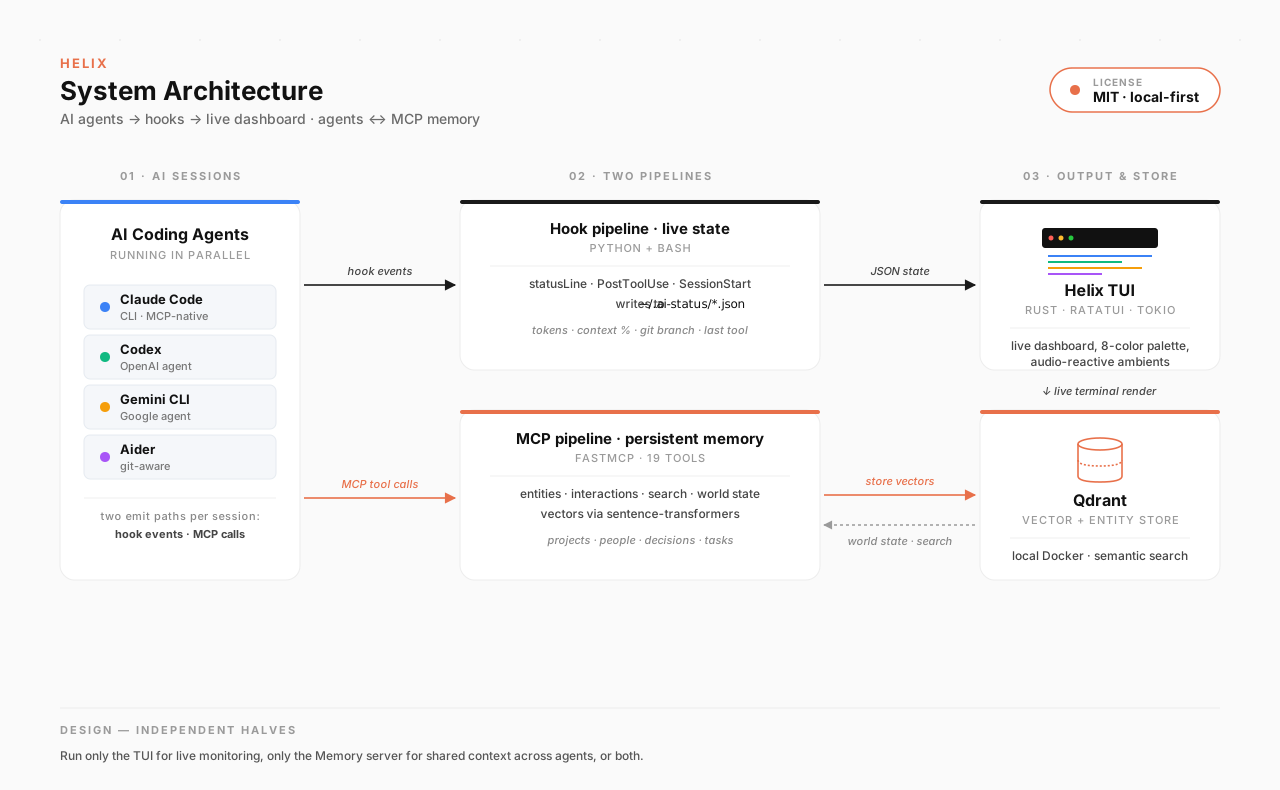
Helix system architecture — AI sessions emit hook events and MCP calls; hooks pipeline writes JSON state for the Rust TUI dashboard, MCP pipeline persists entities and vectors to Qdrant for semantic search.

Helix is two systems plumbed together via shell hooks.

  • Helix TUI — Rust terminal dashboard. Built on Ratatui + Tokio. Watches a directory of state files (~/.ai-status/*.json) that hook scripts write on every tool call and status update. Each running session shows up as a card with one of 8 palette colors (Cyan / Amber / Rose / Lime / Violet / Ice / Ember / Moss), live token/context/branch info, and a real-time activity feed with a recency gradient. Three themes (Cyberpunk / Clean / Retro), 12 audio visualizer styles, ambient effects (matrix rain, breathing glow, fireflies, lava lamp, fractal plasma, cosmic eye), alert flash when a session crosses 80 % / 90 % context.
  • Helix Memory — Python MCP server. 19 MCP tools for entities (projects, people, decisions, tasks), interactions, and semantic search. Backed by Qdrant for vector storage and sentence-transformers for embeddings. Exposes a helix_get_world_state tool that returns urgent items + deadlines + stale threads — agents call it at session start to load full project context in one shot. Time-decay on interactions, automatic archival.
  • Hook scripts. Small Python + Bash scripts that bridge Claude Code (and other agents that emit hook events) into the state-file directory the TUI watches, and into the MCP memory server.

The two halves are independent — you can run only the TUI, only the memory server, or both.

result
Self-hosted, MIT-licensed, public on GitHubMulti-agent support — Claude Code, Codex, Gemini, Aider, anything MCP-compatible (Cursor, Windsurf)The memory server is the same one powering this portfolio rebuild, the Sound Canvas case study, and every other project I'm tracking — dogfooded dailyLocal-first: Qdrant runs in Docker on your machine, no cloud calls
👇 Converse
👇 T-shirt #1
👇 T-shirt #1
result
  • 3,000+ visitors participated across the 2-day conference.
  • Hundreds of unique album covers generated, all surfaced live on the gallery wall, each tagged with the visitor's name.
  • First AI art installation at an Indian music conference.
  • Architecture validated as portable to product customization (T-shirt + Converse).
👇 Sunny MR (ChordFather) on Sound Canvas
"He has made an AI-assisted workflow on the iPad — AI cover art that just works. A lot of people were interested. Next year we'll bring more of this in a bigger way."                
— Sunny MR, ChordFather Studio